Category Archives: Politics & Society

>"America is just as much a colonial power as England ever was." Do you agree?

>These were the words spoken by Malcom X in 1964. The whole quote was:

“America is just as much a colonial power as England ever was. America is just as much a colonial power as France ever was. In fact America is more so a colonial power than they, because she’s a hypocritical colonial power. What do you call second class citizenship? Why, that’s colonisation. Second class citizenship is nothing but twentieth century slavery.”

Was he right to say such things in 1964? Would he be right today?

>To what extent should places like China have the freedom to handle human rights issues as they want?

>Western democracies are liberal democracies. We believe in upholding basic human rights, and ensuring the freedom of the individual insofar as they doesn’t enfringe upon the freedoms of others. But would freeing people like Liu Xiaobo enfringe upon the liberties of others? Do we have a right to say our way is undeniably better, and that there are no disadvantages with ordering his release? Or is China right to suspect that violence and unrest might walk hand in hand with greater freedom to protest? After all China learnt a lesson from Gorbachev; and much of the reason why they keep such a tight reign on the country is because of the perceived lessons from that period of Soviet history.

>What’s the future for liberalism in speech?

>Etienne de Durand of the French Institute of International Relations said in this last week that cooperation between the UK and France in defence was about “being sex buddies rather than marriage.” I just picked this example because it was to hand, yet there’s a vast amount of modern literature that uses words like “fuck buddies” (the more common term).

My question to you is do you see this kind of liberalisation of speech continuing, and perhaps as something that people are more likely to read in even academic works in the future? Or does seeing such vocabulary on an academic site make you squirm? Is there a right and wrong to discuss here or not? Is it simply a product of the times?

>To what extent do we own our bodies?

>Hillel Steiner, a political philosopher, wrote about how he spotted several teenagers in his local supermarket with t-shirts saying “Sell your body”. As it turns out they were selling advertising space, but Steiner used the point to note approvingly that the right of self-ownership, which he saw as implied in the slogan, is one of the key human rights. Under this logic we should have the right to sell our bodies, as well as the right to refuse to do so.

Steiner hits upon a subject that often comes up in everyday language. Ever heard the phrase “it’s my body and I’ll do what I want with it”? This is not necessarily what people who say this mean, but it implies a division between mind and body. It implies that the real us is our mind, and that our body is our property, to do with as we wish.

The two most obvious views to the contrary come from religion, and from Marxism. In one of St Paul’s letters to the Corinthians he tells them that their body is “a temple of the holy spirit, who is in you, whom you have from God, and you are not your own.” Opinions within other major religions like Islam and Judaism are similar. Yet there are many other objections to the idea of treating the body as a marketable commodity. Marxism implies that to think of your body thus is the ultimate in capitulation to Capitalism. Indeed Marxist thinker George Lukács took it as the final stage in self alienation.

What do you think? Should we have the right to sell bits of our bodies as we please? Should our bodies be treated as property? Should they even be treated as ours?
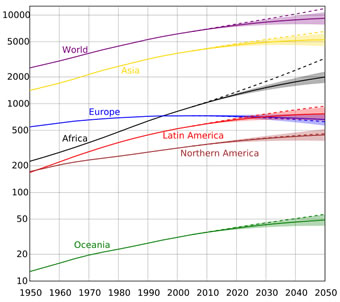
>What is a sustainable global population? How many people can we sustain?

>”The biggest single challenge facing the Earth…is not global warming. That is a secondary challenge. The primary challenge facing our species is the reproduction of our species itself.”

Boris Johnson, The Telegraph

These are the forecasts for population growth up until 2050. The world’s population growth rate peaked in the early 1970s. The global population doubled from 3 billion in the 1960s to 6 billion in mid-1999, and continues to rise — but at a slower rate. The question is where on that chart above should we draw a line, saying ‘population must not exceed!’?

>What is the value of humility?

>Is humility always good, or not? We’ve heard of the ‘greats’ of history, humbly refusing awards and/or praise. Take the following example of Einstein speaking to the Chicago Decalogue Society in 1954:

“Ladies and gentlemen: You are assembled today to devote your attention to the problem of human rights. You have decided to offer me an award on this occasion. When I learned about it, I was somewhat depressed by your decision. For in how unfortunate a state must a community find itself if it cannot produce a more suitable candidate upon whom to confer such a distinction?”

Now you may argue that this wasn’t humility, for he really didn’t do that much related to human rights. But nevertheless he was humbly refusing an award he could easily have embraced.

What would you have done? Is it the case that there is a time and a place for humility? Are these people just trying to call more attention to themselves? Does humility serve the humble, or just the rest of us?

>Should all of us be active do-gooders?

>Marianne Williamson once wrote “our deepest fear is not that we are inadequate. Our deepest fear is that we are powerful beyond measure. It is our light, not our darkness that most frightens us.’ We ask ourselves, Who am I to be brilliant, gorgeous, talented, fabulous? Actually, who are you not to be? You are a child of God. Your playing small does not serve the world. There’s nothing enlightened about shrinking so that other people won’t feel insecure around you. We are all meant to shine, as children do.”

Now I’m aware that Williamson’s argument was not exactly in line with the question but it raises some interesting points. Do we fear our strengths as much as, or perhaps even more than our weaknesses? Does “our playing small” not serve the world? Should we all be more active? Or is it acceptable for someone to turn down an evening of volunteering when they know they’d be doing nothing otherwise? Is it acceptable for someone to work their entire lives on the minimum wage when they have the potential to do so much more?

« Older Entries Recent Entries »