Category Archives: Other

>Happy New Year

>Sorry for my absence lately. I’m without the internet temporarily.

So to bide the time until I’m back on the site please feel free to list any questions you want to discuss here.

I’ll start it off: if 2011 is the real start of the tens decade then what is your opinion about what will be the key moments and themes of the Noughties that historians point too in fifty to a hundred years?

>What was it that made the great leaders great?

>Analyse the great leaders of history and you’ll learn about the positive traits that enabled them to find success, whether it be wit, oratory skills, strength, or any number of different abilities. Yet in all the world many people have these skills. So is it more about being in the right place at the right time? Or would the right person always find their way to the top irrelevant of what structures they’re pitted up against?

>"America is just as much a colonial power as England ever was." Do you agree?

>These were the words spoken by Malcom X in 1964. The whole quote was:

“America is just as much a colonial power as England ever was. America is just as much a colonial power as France ever was. In fact America is more so a colonial power than they, because she’s a hypocritical colonial power. What do you call second class citizenship? Why, that’s colonisation. Second class citizenship is nothing but twentieth century slavery.”

Was he right to say such things in 1964? Would he be right today?

>To what extent should places like China have the freedom to handle human rights issues as they want?

>Western democracies are liberal democracies. We believe in upholding basic human rights, and ensuring the freedom of the individual insofar as they doesn’t enfringe upon the freedoms of others. But would freeing people like Liu Xiaobo enfringe upon the liberties of others? Do we have a right to say our way is undeniably better, and that there are no disadvantages with ordering his release? Or is China right to suspect that violence and unrest might walk hand in hand with greater freedom to protest? After all China learnt a lesson from Gorbachev; and much of the reason why they keep such a tight reign on the country is because of the perceived lessons from that period of Soviet history.

>"Insanity in individuals is something rare – but in groups, parties, nations, and epochs, it is the rule."

>This is a quote from Nietzche. It’s perhaps quite odd to come from someone that many people would have labelled mad himself. Indeed the very next thing he wrote was “the thought of suicide is a great consolation: by means of it one gets succesfully through many a bad night”, which at the very least suggests mental illness, and also a different way of thinking.

But was Nietzche right? Is this why we frequently get so angry with decisions taken at the group level, but can accept the freedom of individuals to act as they will? Is there anything to what Nietzche said at all?

>Are you for or against legalising Euthanasia?

>A few sites to help you get your head round the debates as they stand thus far:

  1. http://www.bbc.co.uk/ethics/euthanasia/against/against_1.shtml
  2. http://www.world-faiths.com/GCSE%20Short%20course/reasons_for_and_against.htm
  3. http://www.smh.com.au/nsw/legal-euthanasia-does-not-increase-rate-says-belgian-expert-20101028-175u8.html
  4. http://www.montrealgazette.com/news/Doctor+warns+against+legalizing+euthanasia/3642395/story.html

>Is the human race doomed to die out?

>Look at every intelligent species in our planet’s history, from the dinosaurs to elephants and apes today. Most intelligent species grow in number, live a while, and then die off. Whereas less intelligent species like bacteria and viruses thrive, no matter what’s thrown at them.

The key reason is that intelligence requires complexity, and complexity means slower evolution. Single celled organisms evolve incredibly fast, because they reproduce very fast, and because they’re very simple so it’s easy for them to change. So in other words as we continue to evolve we’ll get more intelligent, but we’ll also become more complicated, or so the theory goes, and we’ll therefore evolve less quickly.

Two interesting questions arise out of this:

  1. Will we one day (or are we already) be so slow in adapting to changing environments that any radical change will wipe out our entire species?
  2. Just as Einstein’s theory of Special Relativity stops us travelling too fast and too far, does evolution imply that the laws of science prevent evolution beyond a certain point?
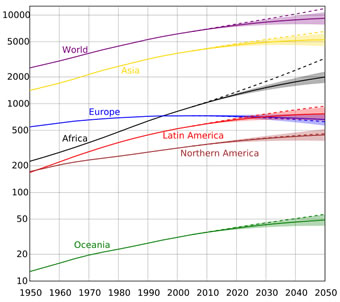
>What is a sustainable global population? How many people can we sustain?

>”The biggest single challenge facing the Earth…is not global warming. That is a secondary challenge. The primary challenge facing our species is the reproduction of our species itself.”

Boris Johnson, The Telegraph

These are the forecasts for population growth up until 2050. The world’s population growth rate peaked in the early 1970s. The global population doubled from 3 billion in the 1960s to 6 billion in mid-1999, and continues to rise — but at a slower rate. The question is where on that chart above should we draw a line, saying ‘population must not exceed!’?

>Is there going to be a global second dip?

>Pre-recession China was an export dependent country, which was growing so fast that it was at risk of overheating. It was considered to be dependent on the US buying all the Chinese goods too. Since then the US has suffered its worst recession since the Great Depression, and aggregate demand has slumped. So why and how is China booming again?

There are 3 possibilities:

  1. The US private level of debt is still rising, along with consumption
      1. Not true. The US entered recession with household levels of debt at 130% and have now lowered them to below 100%. Unless the rich is making up for the rest of society’s shortfall in consumption then it seems obvious that falling income and falling debt means China is not increasing sales in the US.
  2. China is selling to other countries instead.
      1. Chinese companies are certainly trying o open up new markets in other countries, but can they do it within a few months? The richest peoples in the world are now in recession, so it’s unlikely that anyone was able to fork out for the big deals.
  3. China managed to switch from an export led country to an import based one in the space of a year.
      1. There are examples of firms that have been trying to do this e.g. Chinese automakers. But this kind of change in an economy takes generations, not months. So China has not become an import based country.
  4. China used its stimulus to buy and stockpile Chinese goods in the hope that the recession would be temporary, and will not be able to maintain these efforts for long.

If this isn’t scary enough (please do suggest other possibilities) there is also a real estate bubble in China, which China is struggling to suppress.

And that’s without getting into the policy debate in the West. Though I will ask you this: are there any more products/assets to bubble? First there was the dot.com boom; then the real estate and mortgage boom. Is there anything left to bubble? Will the next things to bubble and burst be commodities, and metals like gold?

What do you think?

« Older Entries Recent Entries »